
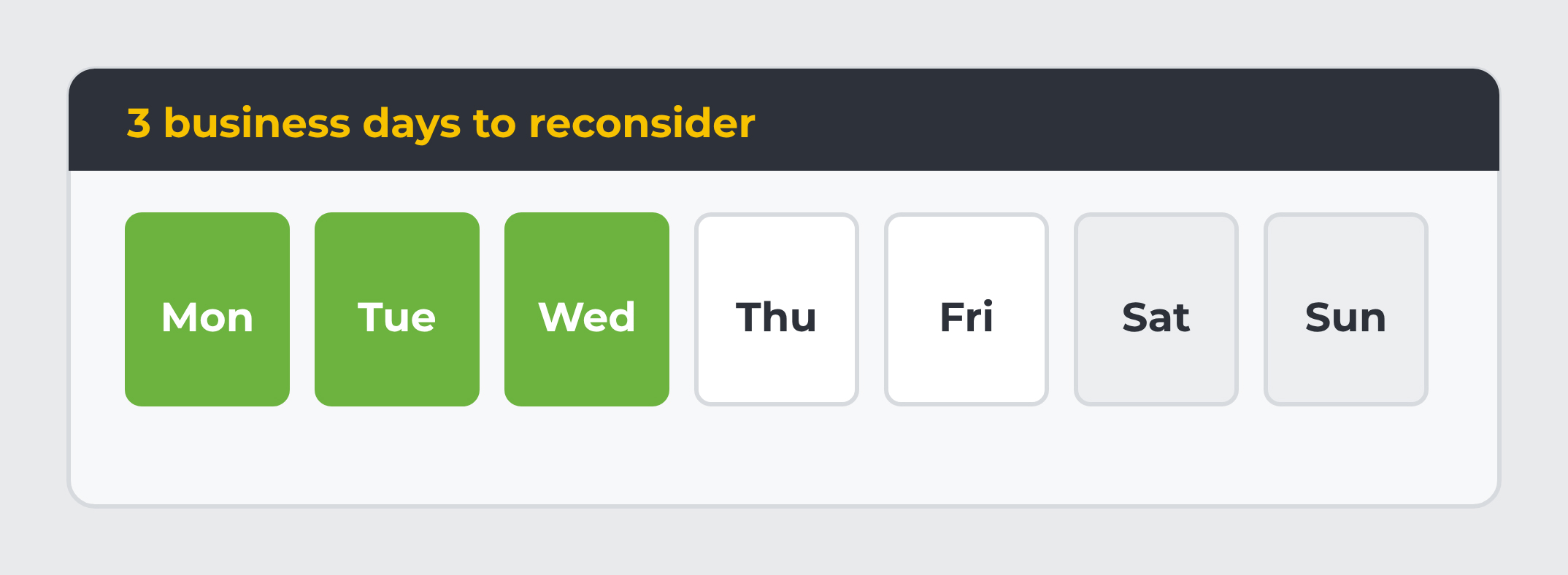
Sign a loan agreement on a Monday, and by Thursday you can still walk away from it.
That is the practical effect of a rule that took effect on 15 September 2026. The Ministry of Law introduced a mandatory cooling-off period of three business days on unsecured loans from licensed moneylenders, announced on 31 August. During those three days, a borrower can cancel the loan and repay it at a reduced cost, without paying any interest.
For anyone who has ever signed for credit and felt uneasy about it on the walk home, the window is the point. What follows is what it covers, how the days are counted, and exactly what canceling will cost you.
The window: three business days, and what “business” removes
The cooling-off period runs for three business days. Saturdays, Sundays and Singapore public holidays are excluded from the count, which means the calendar length varies depending on when you sign.
A loan granted on a Monday reaches the end of its window on Thursday. A loan granted on a Thursday does not reach the end until the following Tuesday, because the weekend in between does not count. Add a public holiday and the deadline moves out by another day. In practice the window is almost always longer than three calendar days, and occasionally close to a week.
What canceling costs
Before this rule, canceling was expensive. A licensed moneylender was entitled to keep the entire loan approval fee along with any interest that had accrued in the meantime. A borrower who changed their mind within a day still lost the full fee.
That position has now been replaced. If you cancel during the cooling-off period, the lender may retain only a portion of the loan approval fee, and nothing else. The Ministry of Law set the limits as follows:
For unsecured loans of S$5,000 or less — the lender may keep a maximum of S$50, and never more than the loan approval fee it actually charged.
For unsecured loans above S$5,000 — the lender may keep a maximum of 3.5 per cent of the loan principal, and again never more than the approval fee it actually charged.
That retained amount is there to cover the overheads and due diligence costs a lender incurs when assessing and granting a loan. Everything else falls away. No interest is charged, whatever rate appears in the contract, and the total sum you repay can never exceed the principal of the loan.
The arithmetic is straightforward. You repay the amount that was actually disbursed to you, after the approval fee was deducted upfront, plus whichever portion of that fee the lender is permitted to keep.
Two worked examples
The Ministry of Law published two illustrations, and they are worth following closely because they show the two limits behaving differently.
A S$1,000 loan. The lender charges a 10 per cent approval fee, or S$100, and deducts it upfront. You receive S$900. You then cancel within the cooling-off period. Because the principal is S$5,000 or less, the lender may keep a maximum of S$50. You repay up to S$950: the S$900 that reached you, plus the S$50 retained. The other S$50 of the fee comes back to you, and no interest is payable.
A S$10,000 loan. The lender charges a 2 per cent approval fee, or S$200, deducted upfront. You receive S$9,800. You cancel within the window. The loan sits above S$5,000, so the 3.5 per cent limit applies, which would allow the lender to keep S$350. But the retention can never exceed the fee actually charged, and only S$200 was charged. The lender keeps S$200. You repay up to S$10,000: the S$9,800 you received plus the S$200 retained.
The second case shows the cap doing the work that matters. The 3.5 per cent figure is a ceiling, not an entitlement. A lender that charged a modest approval fee cannot reach past it to claim a larger share.
Which loans are covered, and which are not
The framework applies to all unsecured loans from licensed moneylenders, with one carve-out: business loans sit outside it. Borrowing for personal reasons puts you inside the protection. Medical bills, a family emergency, a repair that could not wait, a gap between paydays.
It also applies only to licensed moneylenders, meaning those licensed under the Moneylenders Act and listed on the Registry of Moneylenders maintained on the Ministry of Law’s website. An unlicensed lender is outside this rule and outside every other borrower protection the Act provides, which is the most practical reason to check the register before signing anything.
Two long-standing rules are worth repeating alongside the new one, because they are useful tests of whether you are dealing with a licensed lender at all. A licensed moneylender cannot solicit loans through text messages, phone calls or social media platforms. And it must meet you in person at its approved place of business to carry out physical face-to-face verification of your identity before granting any loan. A loan offer that arrives by SMS, or a lender willing to disburse without ever meeting you, is not operating within the rules.
How to cancel
[Insert your own process here: the channel a borrower should use, what they need to bring or send, your operating hours, and how quickly you confirm cancellation in writing.]
Two habits apply whichever lender you borrowed from. Put the cancellation in writing even if you also give notice in person, so the date of your request is documented. And ask for written confirmation of the final amount payable before you transfer anything, so the figure can be checked against the limits set out above.
Where the rule came from
The Ministry of Law developed the framework in consultation with the Credit Association of Singapore, the professional association representing licensed moneylenders. Its stated aim is to strike a balance: giving borrowers room to reconsider a credit decision that may have been made on impulse, while still ensuring lenders are compensated for the work involved in granting a loan.
The 15 September start date was chosen deliberately, in recognition that lenders needed time to adjust their processes and systems. The Registry of Moneylenders, which sits under the ministry, continues to work with the relevant parties on implementation.
Three other changes from earlier this year
In April 2026, the Registry updated its Professional Service Handbook for licensed moneylenders to encourage three further practices. These are recommendations rather than obligations, so they vary between lenders, which makes them worth asking about before you borrow:
- Incentives for good repayment — discounts or rebates on interest or fees where a loan is repaid on time or settled ahead of schedule.
- Digital touch points — tools such as an online portal that let borrowers monitor their loan servicing and manage their finances.
- Support for borrowers in difficulty — restructuring repayments to suit a borrower’s actual financial situation, or referral to a Social Service Agency.
The third one is the question to ask before signing rather than after. Knowing in advance whether a lender will restructure if your circumstances change is more useful than discovering the answer once you have already fallen behind.
The ministry has said it will continue to balance borrower protection against maintaining reasonable access to credit from licensed sources.
Using the window well
Three business days is enough time to do three things: reread the agreement without the pressure of the counter, work out the total repayable across the full tenure rather than looking only at the monthly instalment, and check whether another licensed lender, a hardship scheme, or a family arrangement covers the need instead.
It is not enough time to recover from a loan you could never afford to service. The cooling-off period is a safeguard around the decision, not a substitute for making it carefully. But if the reason for borrowing has dissolved a day or two later, canceling now costs S$50 on a small loan rather than months of interest.
Sources
- Ministry of Law, “Mandatory Cooling-off Period for Loans Taken from Licensed Moneylenders”, 31 August 2026
- Registry of Moneylenders, Professional Service Handbook for Licensed Moneylenders, v3, 1 April 2026
1-Apex Credit Pte Ltd is a moneylender licensed by the Ministry of Law, Singapore, license number [148/2025]. This article is general information about a regulatory change and is not financial advice.